05.05.2026
Transfemoral Aortic Valve Implantation — TAVI: A Minimally Invasive Solution for Severe Aortic Stenosisa
Minimally Invasive Aortic Valve Treatment for International Patients
Transfemoral Aortic Valve Implantation, commonly known as TAVI or TAVR, is an advanced minimally invasive heart valve procedure used to treat severe aortic valve stenosis. For many patients, especially elderly individuals or patients who may be at increased risk for open-heart surgery, TAVI offers a modern alternative to conventional surgical aortic valve replacement.
At RecMed Medical Travel Company, we support international patients seeking advanced cardiovascular treatment in Turkey by coordinating specialist doctor evaluations, hospital admission, diagnostic planning, translation support, VIP transfers, accommodation assistance, and post-treatment follow-up. RecMed’s service model is built around making healthcare access simpler for international patients, offering direct access to specialist doctors together with accommodation, transfers, translators, and post-treatment care coordination.
Turkey has become a preferred destination for patients from the USA, Canada, Germany, CIS countries, and the Balkans who are searching for high-quality cardiovascular care, experienced physicians, modern hospitals, shorter planning times, and transparent medical travel coordination.
What Is Aortic Valve Stenosis?
The aortic valve is one of the most important valves of the heart. It controls blood flow from the left ventricle into the aorta, the main artery that carries oxygen-rich blood to the body.
Aortic valve stenosis occurs when this valve becomes narrowed, stiff, or calcified. As the valve opening becomes smaller, the heart has to work harder to pump blood through the body. Over time, this can lead to serious symptoms and life-threatening complications.
Common symptoms of severe aortic stenosis may include:
- Chest pain or pressure
- Shortness of breath
- Fatigue
- Reduced walking capacity
- Dizziness
- Fainting episodes
- Irregular heartbeat
- Swelling in the legs
- Heart failure symptoms
Severe symptomatic aortic stenosis should not be ignored. Once symptoms appear, patients usually require timely evaluation by a cardiology and heart valve team. The 2020 ACC/AHA valvular heart disease guideline emphasizes that patients with severe valve disease being considered for valve intervention should be evaluated by a multidisciplinary heart valve team.
What Is Transfemoral TAVI?
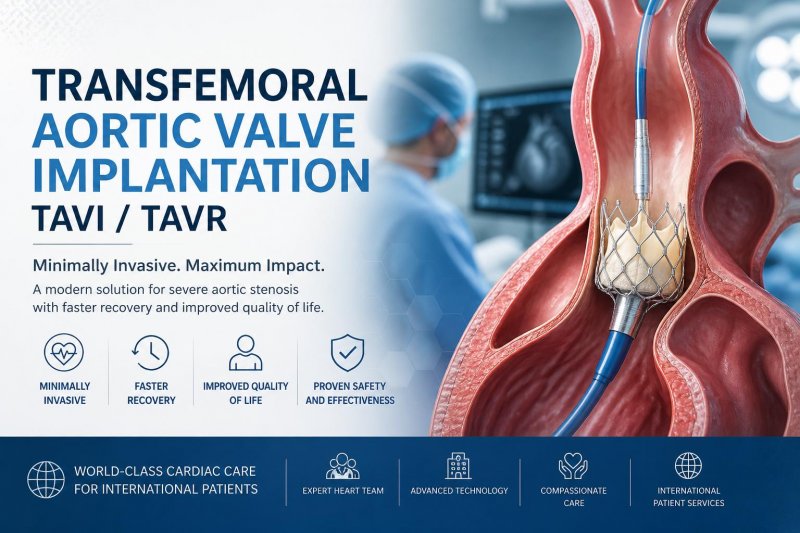
Transfemoral TAVI is a catheter-based procedure in which a new aortic valve is implanted through the femoral artery, usually accessed from the groin area.
Instead of opening the chest, the cardiology team inserts a thin catheter through the artery and guides the replacement valve to the heart. The new valve is positioned inside the diseased aortic valve. Once expanded, it pushes the old valve leaflets aside and begins working immediately.
The American Heart Association explains that TAVI/TAVR is a minimally invasive procedure where a new valve is inserted without removing the old damaged valve; the new valve is placed inside the diseased valve. The U.S. National Heart, Lung, and Blood Institute also describes TAVR as a minimally invasive procedure that replaces a diseased aortic valve without open-heart surgery, requiring only a small skin incision.
TAVI or TAVR: What Is the Difference?
TAVI and TAVR usually refer to the same procedure.
TAVI means Transcatheter Aortic Valve Implantation.
TAVR means Transcatheter Aortic Valve Replacement.
The term TAVI is more commonly used in Europe, Turkey, the CIS region, and the Balkans. The term TAVR is more commonly used in the United States and Canada.
For this reason, international patients may see both names when researching treatment options. Medically, both terms refer to the catheter-based implantation of a new aortic valve.
Who May Be a Candidate for TAVI?
TAVI may be recommended for patients with severe symptomatic aortic stenosis, especially when open-heart surgery carries increased risk or when a minimally invasive approach is considered more suitable.
A patient may be considered for TAVI if they have:
- Severe aortic valve stenosis confirmed by echocardiography
- Shortness of breath, chest pain, fainting, fatigue, or reduced physical capacity
- Advanced age
- Previous heart surgery
- High or intermediate surgical risk
- Frailty or reduced ability to tolerate open-heart surgery
- Suitable vascular anatomy for femoral artery access
- Additional medical conditions such as kidney disease, lung disease, diabetes, or coronary artery disease
However, TAVI is not automatically suitable for every patient. The decision must be made after a full diagnostic evaluation, including imaging of the aortic valve, heart function, coronary arteries, and femoral arteries.
The 2021 ESC/EACTS guidelines for valvular heart disease highlight the importance of individualized decision-making and Heart Team assessment when choosing between TAVI and surgical aortic valve replacement.
Who May Not Be Suitable for TAVI?
Some patients may still need conventional surgical aortic valve replacement. TAVI may not be suitable if the patient has:
- Unsuitable femoral arteries
- Severe vascular calcification or narrowing
- Active infection, such as infective endocarditis
- Aortic anatomy that prevents safe valve placement
- Need for other major heart surgery at the same time
- Certain complex valve conditions
- Very long life expectancy where surgical valve strategy may be more appropriate
- Anatomical factors that increase procedural risk
This is why RecMed always recommends pre-treatment medical document review before confirming a final treatment plan.
How Is Transfemoral TAVI Performed?
The transfemoral TAVI procedure is performed in a specialized cardiac catheterization laboratory or hybrid operating room by an experienced interventional cardiology and cardiac surgery team.
1. Pre-TAVI Diagnostic Evaluation
Before the procedure, the patient undergoes detailed evaluation to confirm whether TAVI is safe and appropriate.
The diagnostic workup may include:
- Cardiology consultation
- Cardiac surgery consultation if needed
- Transthoracic echocardiography
- Transesophageal echocardiography if required
- CT angiography of the aorta and femoral arteries
- Coronary angiography or coronary CT angiography
- ECG and rhythm assessment
- Blood tests
- Kidney function tests
- Anesthesia evaluation
- Heart Team review
CT angiography is especially important because it helps doctors measure the aortic valve area, choose the correct valve size, and evaluate whether the femoral arteries are suitable for safe access.
2. Femoral Artery Access
The procedure is usually performed through a small puncture or incision in the groin. The catheter is inserted into the femoral artery and carefully advanced toward the heart.
3. Valve Placement
The replacement valve is compressed onto the catheter and delivered to the diseased aortic valve. Once the valve is correctly positioned, it is expanded inside the native valve.
4. Immediate Valve Function
After deployment, the new valve starts working immediately. The medical team checks valve position, blood flow, pressure gradients, rhythm status, and possible leakage around the valve.
5. Post-Procedure Monitoring
After the procedure, the patient is monitored closely for heart rhythm, blood pressure, vascular access healing, kidney function, and general recovery.
Benefits of Transfemoral TAVI
For properly selected patients, transfemoral TAVI may offer important advantages compared with traditional open-heart surgery.
Potential benefits include:
- No opening of the chest
- No cutting of the breastbone
- Usually no need for a heart-lung machine
- Smaller access site
- Shorter hospital stay
- Faster mobilization
- Less physical trauma
- Faster recovery compared with open surgery
- Improvement in shortness of breath and exercise tolerance
- Suitable option for many elderly or high-risk patients
Mayo Clinic describes TAVR as a treatment for a narrowed aortic valve that does not open fully and notes that aortic stenosis blocks or slows blood flow from the heart to the body. Cleveland Clinic also describes TAVR as a minimally invasive procedure in which a catheter is inserted, typically through the groin, to deliver a new valve inside the old one.
Risks and Possible Complications
Although TAVI is minimally invasive, it is still a serious heart procedure and must be performed only after careful evaluation.
Possible risks may include:
- Bleeding at the access site
- Vascular injury
- Stroke
- Heart rhythm problems
- Need for permanent pacemaker
- Valve leakage
- Kidney injury related to contrast dye
- Infection
- Blood clots
- Heart attack
- Valve malposition
- Need for emergency surgery in rare cases
The risk level depends on the patient’s age, heart function, kidney function, vascular anatomy, previous heart disease, general health status, and procedural complexity.
At RecMed, our opinion is that international patients should receive realistic, medically honest information before travel. TAVI can be an excellent solution for the right patient, but it should never be presented as a “simple procedure” without proper risk evaluation.
TAVI vs Open-Heart Aortic Valve Replacement
Both TAVI and surgical aortic valve replacement are established treatments for severe aortic stenosis. The right choice depends on the patient’s age, anatomy, surgical risk, life expectancy, and long-term valve strategy.
TAVI May Be More Suitable For:
- Elderly patients
- Patients with high or intermediate surgical risk
- Patients with previous open-heart surgery
- Patients with frailty
- Patients who need faster recovery
- Patients with suitable femoral artery anatomy
- Patients who may not tolerate open-heart surgery well
Open-Heart Surgery May Be More Suitable For:
- Younger patients
- Patients with long life expectancy
- Patients needing multiple cardiac procedures
- Patients with unsuitable vascular anatomy
- Patients with certain complex valve conditions
- Patients requiring surgical correction of other heart problems
Recent evidence has expanded the role of TAVI in selected lower-risk patients, but the decision must remain individualized. Long-term durability and future valve planning are especially important for younger patients.
Recovery After TAVI
Recovery after transfemoral TAVI is usually faster than recovery after open-heart surgery. Many patients can begin gentle mobilization within a short period after the procedure, depending on their medical condition and access-site healing.
Hospital stay may vary, but selected patients can often leave the hospital within a few days if there are no complications. Cleveland Clinic notes that most patients can leave the hospital within one day after TAVR, although some patients may require a longer stay depending on their condition and procedure results.
After discharge, patients usually receive instructions about:
- Medication use
- Blood pressure monitoring
- Groin wound care
- Activity restrictions
- Walking and gradual mobilization
- Antiplatelet or anticoagulant therapy
- Dental infection prevention
- Follow-up echocardiography
- Cardiology follow-up
- Travel safety after the procedure
International patients should not fly immediately after TAVI unless their cardiologist confirms that it is safe.
How Long Should International Patients Stay in Turkey?
For international patients, the expected stay in Turkey depends on the patient’s condition, diagnostic needs, procedure schedule, and recovery.
A typical international TAVI journey may include:
- Arrival in Turkey
- Initial cardiology consultation
- Diagnostic tests and imaging
- Heart Team evaluation
- TAVI procedure
- Hospital monitoring
- Post-procedure echocardiography and blood tests
- Final cardiology clearance
- Return-home planning
In many cases, patients may need approximately 7 to 14 days in Turkey. Complex cases may require a longer stay.
Why International Patients Choose Turkey for TAVI
Turkey is an increasingly preferred destination for advanced cardiovascular care because it offers a strong combination of:
- Experienced cardiologists and cardiovascular surgeons
- Modern hospitals and cardiac catheterization laboratories
- International patient departments
- Competitive treatment costs compared with many Western countries
- Shorter planning and treatment timelines
- Multilingual coordination
- Geographic accessibility from Europe, CIS countries, and the Middle East
- High-quality hospitality and recovery environment
For patients from the USA and Canada, Turkey may be attractive due to high private healthcare costs and the desire for faster access to specialist care.
For patients from the CIS region, Turkey offers geographic closeness, Russian-speaking coordination, and advanced hospital infrastructure.
For patients from the Balkans, Turkey is a trusted regional medical destination with strong cultural and travel connections.
For patients from Germany and other German-speaking countries, Turkey can offer private medical access, second opinions, and coordinated treatment planning with experienced specialists.
RecMed’s International Patient Coordination for TAVI
TAVI requires much more than booking a hospital appointment. It requires proper case review, diagnostic planning, safe travel coordination, and close post-procedure follow-up.
RecMed Medical Travel Company assists patients through every stage of the medical journey.
Our coordination may include:
- Pre-arrival medical document review
- Cardiology and cardiovascular surgery evaluation
- Diagnostic planning
- Hospital admission coordination
- Translation and interpreter support
- VIP airport and hospital transfers
- Accommodation assistance
- Family support during treatment
- Medical report translation if needed
- Post-treatment consultation
- Online follow-up after return home
RecMed’s approach is especially useful for international cardiac patients because every step must be organized carefully and safely.
Medical Documents Needed Before Traveling
Before confirming whether TAVI is suitable, patients should send their medical documents for review.
Recommended documents include:
- Recent echocardiography report
- Cardiology consultation notes
- Coronary angiography report, if available
- CT angiography report, if available
- ECG
- Blood test results
- Kidney function tests
- Medication list
- History of previous heart surgery or stents
- Reports related to diabetes, kidney disease, lung disease, stroke, or cancer
- Passport copy for hospital registration and travel planning
If some tests are missing, they can be planned after arrival in Turkey.
TAVI for Patients With Coronary Artery Disease
Many patients with aortic stenosis also have coronary artery disease. In some cases, coronary stenting may be required before or during the same treatment period as TAVI.
The timing depends on:
- Severity of coronary artery narrowing
- Location of the blockage
- Symptoms
- Kidney function
- Bleeding risk
- Urgency of valve treatment
- Overall cardiac condition
For this reason, coronary angiography or coronary CT angiography is often included in the pre-TAVI evaluation.
Life After TAVI
After successful TAVI, many patients experience significant improvement in breathing, walking capacity, chest discomfort, and general energy level.
However, TAVI does not remove the need for long-term cardiology follow-up.
Patients should continue:
- Regular cardiology visits
- Follow-up echocardiography
- Blood pressure control
- Diabetes and cholesterol management
- Medication use as prescribed
- Dental and infection prevention measures
- Healthy nutrition
- Walking and cardiac rehabilitation if recommended
- Smoking cessation if applicable
Patients should always inform doctors and dentists that they have an implanted heart valve.
Frequently Asked Questions About TAVI
Is TAVI open-heart surgery?
No. TAVI is a minimally invasive catheter-based procedure. The chest is not opened, and the breastbone is not cut.
Is TAVI suitable for elderly patients?
Yes, many elderly patients are evaluated for TAVI, especially if open-heart surgery carries increased risk. However, suitability depends on the patient’s anatomy, general condition, and diagnostic results.
How is the valve inserted?
In transfemoral TAVI, the valve is inserted through a catheter placed in the femoral artery in the groin.
How long does the procedure take?
The procedure duration may vary depending on the patient’s anatomy and complexity. The full hospital process includes preparation, valve implantation, monitoring, and recovery.
Can patients travel after TAVI?
Yes, many international patients can travel home after medical clearance. However, flying should only be planned after the treating cardiologist confirms that the patient is stable.
Is TAVI better than open-heart surgery?
TAVI is better for some patients, while open-heart surgery is better for others. The best treatment depends on age, surgical risk, anatomy, life expectancy, and Heart Team decision-making.
Can RecMed arrange the full TAVI process in Turkey?
Yes. RecMed can coordinate medical document review, specialist evaluation, diagnostics, hospital admission, treatment planning, transfers, translation support, accommodation assistance, and post-treatment follow-up.
Conclusion
Transfemoral Aortic Valve Implantation — TAVI/TAVR — is one of the most important advances in modern heart valve treatment. For many patients with severe aortic stenosis, especially elderly or high-risk patients, it may offer a minimally invasive alternative to open-heart surgery with faster recovery and shorter hospitalization.
However, TAVI must be planned carefully. The safest and most effective results come from accurate diagnosis, advanced imaging, Heart Team evaluation, experienced physicians, and structured follow-up.
For international patients from the USA, Canada, Germany, CIS region, and the Balkans, Turkey offers advanced cardiovascular care with strong international patient support. Through RecMed Medical Travel Company, patients can receive organized, multilingual, patient-centered coordination from the first medical review to treatment, recovery, and follow-up.
References
1. American Heart Association. “What is TAVR? (TAVI).”
2. National Heart, Lung, and Blood Institute. “Transcatheter Aortic Valve Replacement.”
3. American College of Cardiology / American Heart Association. “2020 ACC/AHA Guideline for the Management of Patients With Valvular Heart Disease.”
4. European Society of Cardiology / European Association for Cardio-Thoracic Surgery. “2021 ESC/EACTS Guidelines for the Management of Valvular Heart Disease.”
5. European Society of Cardiology. “2025 ESC/EACTS Guidelines for the Management of Valvular Heart Disease.”
6. Mayo Clinic. “Transcatheter Aortic Valve Replacement.”
7. Cleveland Clinic. “Transcatheter Aortic Valve Replacement.”
8. RecMed Medical Travel Company. “Welcome to RecMed Medical Travel Company.”